Tuesday, June 12, 2012

Fertilizer for the mind and body – Using the Energy of Negative Emotions, a Simple Meditation Technique


 In my recent article on “Darkness Emerging as Light” I suggested that the essential energy of negative emotions can be re-worked and re-directed in our life to become a force for the good, and even a force revealing our own enlightened nature. The meditation below is a simple (though not always easy) technique that we can use to:
  •  Work directly to re-direct and transform the energy of  powerful negative emotion
  • Work with at the beginning of a meditation if we are being directly bothered by a negative emotion/thought pattern present in our mind
  • Simply wish to diffuse and recycle ambient negative emotional energy in our bodymind, making it available for us to use in other more positive ways.

The technique is somewhere between a contemplative meditation where we are working with the mind, and a qi-gong type meditation where we are working with the ‘qi’, ‘prajna’ or energy of the body.

Step 1
Sit comfortably in meditation, recognize and rest in a sense of being in a “safe space” for a short while, a safe space meaning here the recognition that at this present time there are no imminent physical or psychological threats to your safety.

Step 2
Bring to mind the negative emotion and accompanying thought patterns that you wish to work with. Try to create it intensively enough so that you can really feel it in your body. This stage can be a bit tricky in that, whenever you try and look at a negative emotion directly it tends to ‘hide’ or ‘disappear’ (and of course there is a lesson in that), so you may have to have to tease it back out again into the open.

Step 3
Ask yourself “Where is the energy of this emotion principally located in my body?” You will probably find that it is somewhere in the torso, between the sacral area and the heart centre, but if it appears to be somewhere else then you can go with that. The main thing is that you should feel you have located the physical and energetic ‘epicenter’ of the emotional disturbance so to speak.

Step 4
See the emotion in that area of your body as being a ball of tightly knotted black light in the centre of that area of your body. At this point let go of the object of your negative emotion (eg the person or situation that has upset you) and simply focus on the ball of light in the body.
See and feel in the centre of that ball an intense point of white light, so that the dark, knotted energy starts to glow from within. Gradually see and feel the knotted dark energy unraveling and lightening. As the energy lightens, it is released from that specific point in the body, and is released and redistributed evenly throughout the rest of the body.

Using the breathing
If you like you can use the breathing to help facilitate this:
As you breathe in, breathe into the centre of the dark energy, seeing the point of light inside growing intensely.
As you breathe out see the point of bright light in the centre expanding through the knotted dark energy, breaking it up and re-distributing it through the body, thus making the energy that has been trapped in the negative emotion re-available for us to use.
(Those of you that are familiar with the way I teach breathing in qi gong will find this basic pattern of breathing familiar, energizing the body upon inhalation, and allowing the energy to flow freely through the body upon exhalation. Here it is the same basic principal applied to a specific area of the body where there is a strong emotional charge).

Step 5 
Conclude the meditation with a brief period of silent awareness, just breathing and focusing on the body as you experience it in the present moment.

Final thoughts
Repeated use of this meditation will sensitize you to build ups of emotional energy in general, and once you are familiar with the basic technique enable you to modulate emotional energy in the body on a more organic, free-form basis.

© Toby Ouvry 2012, you are welcome to use or share this article, but please cite Toby as the source and include reference to his website www.tobyouvry.com

Tuesday, December 13, 2011

Keeping up Your Energy Levels: Sleeping Patterns and Your Liver Qi


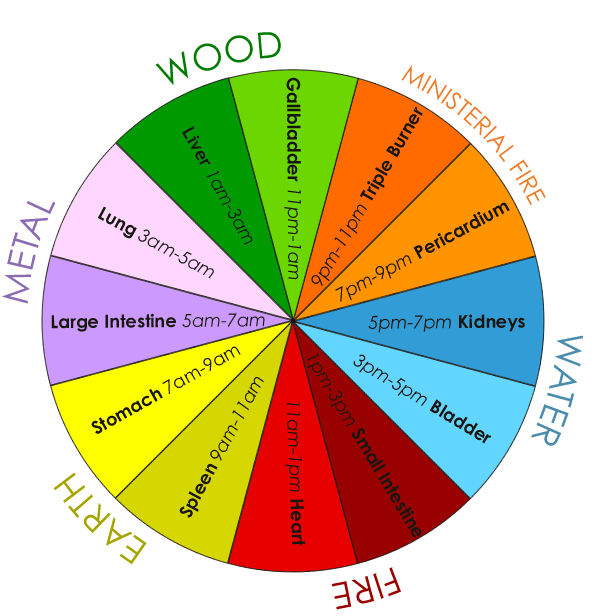
Those of you familiar with traditional Chinese medicine may be aware that each of the organs of the body is assigned a 2 hour period in the 24 hour clock, during which time that particular organ is supposed to be functioning at its optimal level.
For the liver this time is sometimes placed as 11pm-1am, or sometimes 1am-3am. One of the functions of the liver is to detoxify poisons that have built up in the body and the blood stream, and I have heard it recommended (again in TCM circles) that in order to help your liver de-toxify your body and replennish your qi levels it is good to regularly be in bed and sleeping between 11pm and 1am.
As a habitual late night sleeper I have certainly found that getting to bed by 11pm at least once every three days does have a really tangible and positive effect upon my qi levels, and so I strongly recommend it to other people. Simply getting 7 or 8 hours sleep regularly (eg from 1am to 8 or 9am) does not have the same effect for me as getting to be that bit earlier, so that i am lying down and resting as my liver moves into its optimum functioning mode.
So, for this reason, if you are a habitual nightbird like me I recommend getting to bed in good time at least once every three days, for the sake of your overall health and qi!
Finally, here is a digram of the internal organs together with their respective times. If you would like to view an interactive version of this diagram, which details the emotions connected with each of the organs, please click HERE.


© Toby Ouvry 2011, you are welcome to use or share this article, but please cite Toby as the source and include reference to his website www.tobyouvry.com

Friday, November 25, 2011

Our Anxiety in the Face of Inner Space and Stillness


Transcribed from a five minute talk that I gave at the end of a Qi gong meditation class last week (23.11.11), enjoy!

I just want to say one or two things before we end. I mentioned whilst guiding the meditation that one thing that you may become aware of over time is that our mind resists inner space and stillness. If you ask people “Do you want inner peace?” they’ll generally say “Yes, yes, I want inner peace!” but deeper down actually they don’t. To be able to open to inner space and allow it to change you over time takes a lot of courage. This is a major reason why although meditation is free and it has been practiced for millennia as a way of developing mental peace, relatively few people will do it. This is because from the perspective of the ego, the ego has what you might call an existential fear of inner space. Part of the reason why we like to keep ourselves busy all the time, and when we are not doing anything physically our mind likes to think all the time is because we feel as if we have to keep affirming our existence, otherwise we feel like we are going to disappear! It is like a moment to moment fear of death, of dying. Essentially in this context dying means to have no future, becoming nothing. We feel like “If I am not doing something physical then I need to imagine myself doing something physical, because I still want to exist, and if I stop thinking or doing, then I will stop existing”.

This is a little bit of meditational psychology; it is the way in which our mind thinks, but unless we have examined it closely, for most of us this will be a subconscious pattern. And we need to understand that it is natural to have this type of anxiety (the anxiety of becoming non-existent), and simply having this anxiety is not a problem, it is existential anxiety, the natural tension that arises from being alive and wanting to stay that way. So, this in itself is not a problem, what is a problem is if you are not dealing with that anxiety well, if you are repressing it. A lot of psychological pathologies arise from the repression of this natural anxiety which then becomes pathological anxiety, compulsive doing, and compulsive thinking, compulsive everything!

So the natural anxiety of being alive will always be there, even if you continue to meditate. With a bit of practice in meditation you will start to find you can find a sense of inner space and stillness within yourself, but then it becomes an act of courage to keep opening to that space (which to the ego appears to be a type of death, a type of non-existence) and allowing it to inform your experience of life.

So I just thought I would throw that little thought in at the end of our meditation because it is common to find people having a great initial experience of inner space and stillness in their meditation, but then over time drifting away from their practice and this is one of the main reasons. It is not just because we are logistically busy all the time, although life these days is demanding upon our time and energy (although show me a time in history when life has not been such!), it is because our existential anxiety causes our ego to instinctively veer away from inner space and stillness and find excuses not to meditate. Our ego is actually happy to put up with a lot of stress and a lot of pain/problems, fear and anxiety because all of those things are affirming its existence, you know what I mean? Ego is not a bad thing, but the ego has a lot of fears that aren’t really founded upon anything wise and concrete, so it takes a bit of time for it to learn to trust that empty space, that stillness. So we need to keep if you like holding our ego’s hand and saying “Come on, come on, it is not going to be so bad, just relax and let go” like this!

So this is just and aspect of meditation practice that everyone needs to be aware of if you want to sustain your practice, because your mind and ego will try and find a lot of ways to duck out in order to avoid the anxiety of confronting empty space and stillness.

© Toby Ouvry 2011, you are welcome to use or share this article, but please cite Toby as the source and include reference to his website www.tobyouvry.com

Tuesday, August 30, 2011

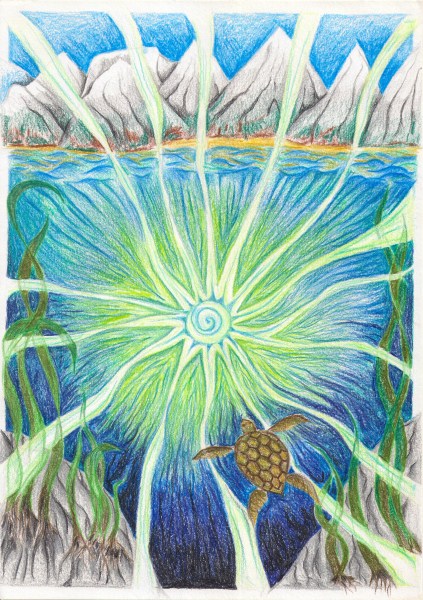
"Water Element Landscape" Soul Portrait Plus Artists Notes by Toby


This is the first of a series of works based around the Chinese five elements (these being earth, wood, fire metal and water). In it you can see a turtle (the power animal associated with the water element voyaging through the deep ocean toward a gentle but powerful water-element energy vortex.
In the distance above the water you can see a mountain and skyscape.

This is a piece of art that you can look at, enter into and meditate with in order to help balance your own water element and emotional being. In particular the water element energy in this picture can help induce balance and spontaneity to your mental processes, and to induce an emotional experience of calmness, spaciousness and flow.

For an overview of meditation on the five elements see Toby’s article“Meditating on the Five Chinese Elements as a Method of Achieving Balance and Harmony Through Dependent Relationship”.


This artwork is currently for sale, for enquiries please contact Toby on this email: info@tobyouvry.com


Image and text © Toby Ouvry, please do not reproduce without permission.

Sunday, April 17, 2011

A Personal Reflection on How Meditation Develops Your Inner Vision and Ability to Work With Energy

Hi Everyone,

Back in 2001 when I left my life as a Buddhist Monk part of the reason was that I wanted to return to a life as an actively working artist expressing his inspiration in paintings and sculpture. As I had meditated during the 1990’s I had touched the inner formless spaces that you find in deep meditation practice, but I had also found that, from these deep formless spaces a lot of inner visions started to emerge quite spontaneously, and that they often really demanded to be expressed.
Since then I have developed a method of combining my meditation and artistic practice where I will meditate on a particular topic or subject for a while in order to receive visual and sensual impressions of its inner nature, and then I will create an art piece based around what I have seen.
In order to give an example of this, at the top of this article you can see a working sketch that I have done for an artwork that embodies the energy of The Tao, Yin-Yang and the five Chinese elements of earth, wood, metal and fire. Here is a brief description of the inner landscape from which this image arose. You can do it yourself if you like, the basic images are simple, and there is plenty of room for creative imagination and to really make the inner landscape your own:

The Asian Tree and the Yin-Yang courtyard.
Before meditating set your intention to travel, within the reality of your creative imagination, to an inner landscape that embodies the spiritual energy of the Tao, Yin-Yang and five elements.
Spend a short while relaxing, focusing on your breathing and stilling your sense of time, space and energy.
After a while you sense yourself within what you intuitively sense is an Asian landscape, in front of you is your “Asian tree”, a tree embodying that embodies the energy of Asian spirituality and that you have a particular inner connection to. Spend a while seeing, feeling and sensing the landscape and the tree; the texture of the bark, the colour of the leaves, the time of day and so forth...
To one side of you in your landscape you see an ancient courtyard. Upon its old wooden doors is inscribed a yin yang symbol.
Passing through the doors to the interior of the courtyard you sense yourself entering into a state of deep peace. The roof of the courtyard is open to the sky. In the centre of the courtyard is a yin-yang symbol made of living light. The light part of the symbol is fed by a stream of bright white star light that comes down from the sky. The dark part of the symbol is fed by a stream of dark light rising from the depths of the earth. Within the courtyard are many beautiful ancient objects, such as bonsai trees, crystals and gemstones. In particular there are sculptures of four creatures:
  • A dragon, embodying the energy of the wood element, of spring, air and morning
  • A phoenix embodying the energy of the fire element, of summer and the noonday sun
  • A tiger embodying the energy of the metal element, of autumn and evening
  • A turtle embodying the energy of the water element, of winter and of night time. 
Each of these statues, although static seems to be alive and radiates its elemental energy in the form of colour. These colours gather around the central yin-yang symbol, flowing around it in an ever changing flow of radiant elemental light.

Deep within the earth beneath the yin-yang symbol is a cauldron, which embodies the earth element and is the source from which the other four elements arise.
Simply sit and relax in this beautiful peaceful space, and as you do so feel the yin-yang and elemental balance within your body mind come back into balance. As your body-mind comes into balance, feel your inner being becoming still and spacious like a deep lake.

Thanks for reading,
Yours in the spirit of the rich landscape of the imagination,

Toby

PS: You can see more of my artwork in the most recent post on my Soul Portrait site:

PPS: If you are not familiar with the 5 elements and want a bit more information, you can find more in my past article on my Qi gong blog:
Similarly, you can also find a previous Yin-Yang meditation there:


Wednesday, March 30, 2011

"Starbathing"

www.tobyouvry.com/soulportraits

Working with and absorbing stellar or cosmic qi is something that is increasingly emphasized as one becomes more advanced along many of the diverse paths of Qi Gong. But there is no reason why you can't start working with it now and enjoy the benefits using the very simple method detailed below. We have recently moved to a house with a roof garden, and so I am enjoying it very much. As well as having the energetic benefits of absorbing star qi, it also helps make the mind very big, spacious and light.

The technique:
Find an appropriate place to lie down at night, under an open sky.
Open your eyes and stare up at the starry sky for a while. Take in the vast expanse of the sky, empty your mind and enjoy the twinkling lights of the stars.
After a while close your eyes and imagine starry light flowing down from the stars and from the night sky into all the cells of your body.
In particular feel three focus points of starry energy and light building in the center of your brain, the center of your chest and the central area of your lower abdomen.
Take your time, finish when ready.
Repeat three times a week, or as often as desired!

© Toby Ouvry 2011, you are welcome to use this article, but you must seek Toby's permission first. Contact info@tobyouvry.com

Wednesday, February 23, 2011

Four Types of Qi That We Can Attune to and Harness For Self and Planetary Healing

Generally when we talk about “qi”  or energy in qi gong it can be quite generic, it is just the energy that flows through life and nature.
We can begin to look at specific types and manifestations of qi by observing landscape, and the way in which it is composed of  the four elements; earth (body of the planet, mountains, tress etc), water(lakes, rivers, oceans), air(sky) and fire (sun and stars).
In each of these four elements qi manifests in a particular way, and has particular powers and characteristics that we can learn to attune to and consciously utilize for healing and energizing purposes.
Below is a meditation for attuning to qi within the four elements in landscape. It is one of the first meditations that I wrote after I left Buddhist monkhood and went back into secular life back in 2001. Once you are familiar with the basic process you can easily use it to attune to the qi within any landscape. Enjoy!
(Note: The four elements used in this article earth, air, fire water is based around the four observable elements in nature. This is different from (but closely related to) the system of five elements that you find in Qi gong philosophy; earth, wood, fire, metal, water).

Mandala and Four Elements Meditation

Find a comfortable position, either seated or lying down, with a straight back.
Spend a minute or so focusing on the breathing and bringing your attention inward.

Bring to mind now a beautiful natural setting that you may be familiar with and love, one that when you think of it makes you feel very relaxed and peaceful and that takes you away from the trials of your daily life. This place should be a landscape that includes both land and a water element, above you you feel the energy of the sun, moon and stars.
(note: If you are able to actually go out physically to such a landscape to do the meditation, then this is great).

Wherever you choose to see yourself, see yourself sitting or lying comfortably on the ground of this place of inner retreat, surrounded by bright sunlight, and cooling shade, as refreshing breezes caress your body.
Feel your feet on the earth, the flowers and wonderful vegetation and water features around you, the only sounds that you hear come from nature.

Take the time now to attune yourself to the your spiritual being  that lies within you, see this as a light and feeling of love at your heart.
Feel your consciousness expanding into the elements of nature surrounding you. As you breathe in and out you can feel your mind blending and merging with the environment around you.
Attune yourself to the earth and rocks, and feel this earth energy moving up through your feet as beautiful golden green light. Feel this light pervading your whole physical body now, clearing and balancing the earth element within you. See it going through your organs, flesh and bones, clearing and balancing their energies  within you. Feel your earth element merging with the harmony of the natural earth element around you.
See the water element arising from the water near you as a clear blue light. See this light surrounding you and entering into the water element in the cells of your own body. See it clearing all of the imbalance and disharmony in your blood, fluids and watery elements of your physical body. See and feel your water element coming into harmony and balance with the water element of nature, with the rivers, lakes and oceans of the planet.
Feel and see the light and fresh air around you now moving into your physical body, fell it move through your lungs and out thru your other organs, thru your arms and hands, thru your legs and feet, thru your neck and head. Feel the pure light and energy of the air element moving into all the spaces in your body, clearing out and balancing your own air element. Feel the air element within you coming into line with the air element within nature, and with the sky.

Feel the heat and golden light of the sun now surrounding you and caressing you. Feel this light moving into your system now, clearing and purifying the fire element within your body. See and feel the regulation and distribution of your heat energy being cleared by this beautiful golden light and heat from the Sun. Feel your fire element now coming one with the fire element of nature.

Now feel the energies of Mother Earth Herself now coming up through your feet chakras into your heart, feel her love for you as one of her children. Feel her heart and yours now coming into harmony and merging as one at your heart. Take this feeling of love and oneness with the Earth Mother as your final object of meditation.

When you feel ready, become fully aware of your physical body and surroundings, and when you are ready, open your eyes.

© Toby Ouvry 2011. You are welcome to use this article, but you must seek Toby’s permission first! Contact info@tobyouvry.com

Wednesday, February 9, 2011

Meditations for Spring Time and the Beginning of the Chinese New Year of the Rabbit

Hi Everyone,
I’m off to Thailand for a week, so this will be my last post for ten days or so. Whilst in Thailand I intend amongst other things, to spend a healthy amount of time simply sitting and attuning to the energies of nature, of the landscape and of the sea.

The turn to February sees the energy of spring starting to manifest in the northern hemisphere. Here are two simple meditations with images that you can work with at this time in the year to attune to the energies of spring and of new beginnings.

The first draws upon traditional Chinese associations of the wood element. The second draws upon traditional images of the Goddess/divine feminine and the child self.

1. Working with the wood element to heal and energize of physical and energy body, mind and emotions:

In Taoist and Qi gong philosophy the season of spring corresponds to the wood element. Spring sees a re-awakening of the green world and an exponential expansion in the growth of trees and plants. Here are some of the qualities and correspondences of the wood element energy:

Wood element healing colour: Green
Direction: Energy rising upward from the Earth
Direction: East
Actions: Countenance or good posture
Bodily organ: Yin organ – Liver, Yang organ – Gall bladder
Emotions: Positive - Kindness, negative - anger/resentment
Mental Quality: Sensitivity (Integrate vision of Child and goddess into this section)
Senses: Vision/sight

Brief meditation on the wood element:

• Sit facing east, imagine a fresh spring breeze blowing from the east, refreshing your mind and body.

• Feel down into the earth beneath you. Sense a vast reservoir of light and energy in the centre of the earth. Sense the colour of this light as gold, white and green. Now see it rising up and filling your body through your feet. Sense this green and gold energy surrounding and infusing your liver and gall bladder. Feel any trapped anger and resentment being stored in these organs being released. Feel the organs being cleansed by the light, and being filled with the energy of kindness and sensitivity.

• Now feel the energy of kindness and sensitivity spreading out into your whole body. In particular feel it going into your eyes and eye sockets, refreshing the power of your inner and outer vision

• Feel the green and gold earth energy in your whole body, breathe it in and out of your physical cells for a few breaths, and then just relax in stillness for a while.

2. Two further images of spring: The Virgin Goddess and the child

The Goddess or divine feminine in her youthful or virgin aspect is a traditional image symbolizing new birth and spring.

The child, or new human life is another image strongly associated with spring, as childhood is when we are in the “spring” of our life.

Meditation images for the Virgin Goddess and the child within

• See yourself in your inner vision sitting in spring landscape (or sit in one physically if you can!). Quietly and intuitively feel yourself attuning to the energy of the season

• A beautiful young maiden approaches you, she is the virgin goddess, the goddess of spring. As she stands before you, three rays of light radiate from her

• Light radiates from her brow to filling your mind, brain and head with the energy and light of clarity

• Light radiates from hear throat to your throat, filling your speech with kindness

• Light radiates from her heart to your heart, filling it with the light of positive empathy, gladness and joy

• You notice that the Goddess is holding a newborn baby in her arms. She offers you the baby. Take it your arms, as you hold it, meditate on the seeds of new life, ideas and projects that you can feel beginning to germinate and grow within your being.

• A young child comes to join you and the Goddess. It is your own inner child. See how s/he appears to you. How easily are you able to relate to her? Try and feel the natural joy and playfulness of your child self as you connect to the child appearing to your imagination.

3. Meditating on the rabbit as a power animal

Because it is the lunar new year of the rabbit, February/March 2011 is also a good time to meditate with the Rabbit as a power animal. Here is a simple way to integrate it into the second Goddess and child meditation above:

• Within your spring landscape see the rabbit (could be one or many) appearing. For a while s/he sits and hops gently around the feet of the Goddess, examining you curiously. After a while (in its time not yours) the rabbit approaches you, allowing you to stroke it, perhaps hold it. Feel your mind and energy connecting to the rabbit and commune for a while in silence. What happens or what you see and experience at this time arises from your communion with the spirit of the rabbit.

Thanks for reading!
Yours in the spirit of Spring,
Toby

PS: On February 22nd and March first I will be leading two classes entitled “Landscapes Of The Mind: Finding Inner Power and Balance In Your Life Through Meditation on Wild Nature And Landscape” all are welcome, if you are not in Singapore the classes are available for purchase as recordings.

Article © Toby Ouvry 2011. You are welcome to use it, but you must seek Toby’s permission first. Contact info@tobyouvry.com

Friday, January 28, 2011

Meditating on the Five Chinese Elements as a Method Achieving Harmony and Balance Through Dependent Relationship

Hi Everyone!

In general meditations on dependent-relationship are very good for developing insight into the way that everything in our life is inter-related. It shows you that if one area of your life is out of balance, then that will affect other parts of your life detrimentally. Similarly, if you focus on getting one imbalanced area of your life back into balance and harmony, then that will affect pretty much all other areas of your life in a positive way too.
One cycle of dependent relationship that I have been enjoying working with recently, both by myself and with students is the Chinese five element cycle, specifically as it relates to our mental and emotional qualities. Here is a brief summary of the five elements, together with their mental and emotional characteristics (emotional section includes emotion when balanced, and the emotions when imbalanced:

EARTH ELEMENT/SEASONS: Balanced mental quality: Clarity, Emotions: Empathy/Anxiety

WOOD ELEMENT /SPRING: Balanced mental quality: Sensitivity, Emotions: Kindness/Anger

FIRE ELEMENT /SUMMER: Balanced mental quality: Willpower/Creativity, Emotions: Hate/Joy

METAL ELEMENT/AULTUMN: Balanced mental quality: Intuition, Emotions: Courage/Grief

WATER ELEMENT/WINTER: Balanced mental quality: Spontaneity, Emotions: Calmness/Fear

So, the point about these five sets of elements and their qualities is that they are all in relationship. For example if you are able to generate mental clarity and appropriate empathy (earth element), then you with then be able to generate appropriate and balanced kindness to yourself and others (wood element emotion), which in turn leads to the experience of joy (fire element emotion). If you read through the list in a contemplative state of mind you will start to develop your own insights into how you can make emotional and mental adjustments in your own life to bring your own “elemental cycle” of emotional and mental dependent relationship into greater harmony and balance.

An example of a five element meditation on dependent-relationship:

Here is an example of one meditation on dependent relationship that I led in class last week
Stage 1: Sitting comfortably, generate an appropriate feeling of empathy (wood element emotion) toward your body and mind. Appropriate empathy means being in touch with the authentic feelings and emotions of your body-mind, without allowing your self-sense to get overwhelmed by them.

If you generate authentic empathy, this will give you a mental sense of clarity (earth element mind) regarding how your body-mind really feels.

Stage 2: If you have mental clarity, you will then be able to extend appropriate and balanced kindness (wood element emotion) toward your body-mind, which in turn will enable them (your body-mind) and you to feel joy (fire element emotion).

Stage 3: With the feeling of joy in your body-mind, and a sense of them both co-operating with you, rather than working against you, it will be quite easy to develop balanced willpower and creativity (fire element mind).

Stage 4: With your willpower working well and in an harmonious way, courage (metal element emotion) will be relatively easy to find within yourself. You will feel in control of your body-mind, and so it will be relatively easy to find that still centre within you where your intuition (metal element mind) resides.

Stage 5: With your intuition and courage working well it will be easy to find a sense of calm within (water element emotion), as well as to be natural and spontaneous (water mind).

Stage 6: Being calm and spontaneous further enhances our earth element qualities of appropriate empathy and clarity, and we find ourself back to the beginning the cycle once more!

So, this is one example of meditating with the mental and emotional qualities of the five elements, as I said above, if you read thought the list of elemental qualities in a contemplative way, personal insights into how these emotional and mental qualities are playing out on your own life will start to flow...
Thanks for reading!

Yours in the spirit of the harmonious five elements,

Toby

© Toby Ouvry 2011. You are welcome to use this article, but you must seek Toby’s permission first. Contact info@tobyouvry.com

Wednesday, January 12, 2011

A Working Defninition of Taoist Meditation

Hi Everyone,
Yesterday I started a series of three classes on the Tao and yin/yang, here is one of the basic principles that we are working with:
One way Taoist meditation could be defined as being focused on finding the balance between polarized, opposing forces. These forces can be categorized as either

- Yin – Feminine, receptive
- Or Yang – Active, dynamic

One point of interest here is that a person or thing is not fixed in their yin or yang nature. Something is always yin or yang IN RELATION TO something else.
For example: I may be a yin, quiet, introverted person in relation to my crazy, party animal brother, but I may relatively speaking be a yang, sociable talkative person in relation to my solitude-loving sister.
Life is always changing, the point of balance in our life is always changing, the challenge of meditating with the Tao is to be aware of the continuous flux, and make appropriate adjustments in your consciousness and action to “stay in the Tao”, or keep in balance.
For example: In the morning I may be behind in my work, so I have to focus on being very active and dynamic before lunch. After lunch I may have caught up on my work, but my body is tired, so I need to slow down, rest and recuperate.
From this definition we can understand that Taoist meditation (and I think we could expand that to meditation in general) is not an entirely passive activity, but a way of coming back into balance, coming back into the middle, and avoiding the extreme/imbalanced expressions of either yin or yang.

A Practical Question for daily practice:
A basic question that we need to ask ourselves is “Where is my optimal point of balance right now, and what actions can I take to reconnect to that balance to the greatest degree possible?”
Try asking yourself this question once in the morning, once in the afternoon and once in the evenining for a week. see where it takes you….

Yours in the spirit of the Tao,
Toby

© Toby Ouvry 2011, you are welcome to use this article, but you must seek Toby’s permission first. Contact info@tobyouvry.com

Sunday, January 2, 2011

Hi Everyone!
Over the next few weeks, starting on the 11th January, I will be doing a series of meditation classes entitled “Finding Your Outer Balance, Inner Harmony and Spiritual Centre Through Meditation on the Tao, Yin Yang and the Five Elements” . Really it is a set of classes looking at some of the spiritual and psychological underpinnings of Taoism and Qi gong, and so I will be posting articles relating to it on this Qi gong blog, rather than my meditation blog that I post most of my meditation material on.

The Tao is often referred to in classical sources such as the Tao Te Ching as “the Great Mother”. This is often taken to mean that the Tao is a path based around a philosophy that emphasizes the feminine, the receptive and the flowing. Indeed Taoism is sometimes called “the Watercourse Way” which refers to its emphasis on flowing around obstacles and deriving its strength from receptivity like water.

I believe that there are many ways in which the Tao is indeed a more feminine, flowing, harmonious form of spirituality. However, what I want to highlight in this article is the true-er meaning of the term “Great Mother” in this context.

Fundamentally, when we talk about the Great Tao, we are talking about a Universal creative force that lies immediately within everyone and everything, and at the same time is transcendent of and lies beyond everyday reality.

The Great Tao is actually beyond any concepts such as yin or yang, masculine and feminine, mother and father. It is the inconceivable, non-dual, oneness of everything and everyone in the Universe. The reason that is called “The Great Mother” is to indicate it’s all embracing nature. It embraces everyone and everything in the universe like a huge, cosmic mother. However, in and of itself it is beyond any kind of masculine/feminine, yin/yang duality, it is the primal unity that lies before yin and yang. It is the source of yin and yang.

One of the main aims of authentic Taoist practice is to harmonize the energies of Yin and Yang within ourselves in such a way that we can go beyond them into the primal, unified wholeness of the Tao. What are the main types of yin/yang harmonization that we are trying to achieve in order to get back in touch with the Tao? Here are some simple and major examples:

• We are trying to harmonize our the inner world of our mind and spirit with the outer world of our daily actions and interactions

• We are trying to balance and harmonize our thinking and feeling

• We are trying to balance and harmonize doing and being

• We are trying to balance strength and willpower with nurturing and love

There are many other such yin/yang polarities. The main point is that the path of the Tao is one of the balancing and harmonizing of the yin and yang elements in our life. When we do achieve this balance, the Great Tao, an experience of the primal oneness and unity of life emerges into our awareness and life. In fact the Great Tao is always with us, within us and around us, but our lack of inner harmony and balance causes us to feel separated from it.

Short breathing exercise for balancing yin and yang, and connecting to the “Great Mother of the Tao”

Look at or visualize a traditional yin /yang circle, such as the one in the illustration at the top of this article.
As you breathe in, feel forceful, energizing yang energy rising within your body and mind.
As you breathe out, feel your mind and body moving into a restful, receptive yin state.
Breathe like this for a while, alternating between yang energy on the in-breath and yin energy on the out-breath.
Now close your eyes. Feel your inhalation and exhalation becoming smooth, relaxed and of equal duration (that is the inhalation and exhalation are of equal length). Feel the yin and yang energies within your body and mind flowing together and becoming a single, unified, non-dual energy.
Identify this single, harmonized, unified energy as the Primal Tao, the Great Mother, beyond yin or yang.
Stay with this harmonized, unified state for a while, finish when ready.

Daily practice:

Try and stay in touch with this feeling of harmony and unity in your daily life. Notice that, even in time of emotional turbulence and outer chaos, if you quieten your mind you can still connect to the Great Mother, the Primal Tao, and feel its presence.
Thanks for reading!

Yours in the Spirit of the Great Mother,
Toby

PS: For those of you in Singapore, this coming Sunday 9th January I am holding a beginners Qi gong Workshop: “How to Raise your Health and Energy Levels with Qi Gong” . An ideal opportunity for those who wish to start a practice to get the knowledge and practical instruction they need!

Monday, November 15, 2010

Developing balanced sensory awareness – Feeing your back and into what is behind you

Balanced sensory awareness can be experienced as an awareness that is evenly distributed between the six aspects of our body (front, back, left, right, top, bottom) and the corresponding directions that surround us (in front, behind, to the left, right, above and below).
Because four of our senses are based toward the front of our head, the bias of our sensory awareness tends to be focused to the front, with subsidiary awareness of the left and right.
General Qi gong practice opens us up also to awareness of the sky and stars above, and planetary qi below.
Which direction is left out of the equation? Yep, it is behind, and using the back of our head, neck and back (as in back of torso) to feel and sense into our world.

Consciously focusing our awareness in the back of our body and learning to sense and feel into what is behind us is an interesting exercise:

• It makes us stop and think/be aware, as it provides us with a new perspective that we do not often focus on
• It gets us out of our mind and into our body
• It brings our overall sensory awareness into balance
• It teaches us to not over-rely upon our visual sense, and to “feel” and “hear” into our world more
• It develops our tactile sense, as the back of our body has no other major sense organs, just the sense of energy and touch coming through the skin receptors
• It is just a pleasant way of re-experiencing your world
Focusing on feeling your back and what is behind you is something that you can do anytime as a mindfulness exercise that will help you balance your overall sensory awareness and get you out of your head.

• You can do it whilst walking along (hint: don’t totally loose awareness of what is in front of you!)
• You can find a piece of open space and practice walking slowly and mindfully backwards, sensing with the back of your body as you go.
• You can take a one minute pause when you are working in front of your computer and just spend that minute focusing on what you feel in your back.
• It is nice to go out and try and sense landscape around you through the back of your body, rather than just seeing and experiencing it from the front and what is in your line of eye-vision

© Toby Ouvry, you are welcome to use this article, but you must seek Toby’s permission first. Contact info@tobyouvry.com

Previous articles on directional awareness:

Balancing your awareness of the six directions

Meditating on extending the six directions and drawing back Wu qi

Saturday, November 6, 2010

Meditating on extending the six directions and drawing back Wu Qi

This is an extension of the basic meditation form explained on my previous article on “Balancing your awareness of the six directions” . The meditation explained below will work in and of itself, but if you have not read the previous article, you might find it useful to do so as a context.

This meditation has the following aims:

• To center ourself in the six directions

• To expand our awareness to go beyond the six directions, moving into a timeless, formless state of emptiness (or Wu Qi)

• To then draw back the infinite energy of Wu Qi into our temporal minds and bodies

From this brief outline we can see that the meditation invites experience of the deeper, mystical expressions of qi, and shows how to draw upon this deeper level of qi, drawing it back into our everyday minds and bodies in a way that is beneficial to their health and wellbeing.

The meditation on extending the six directions and drawing back Wu Qi:

1. Centre yourself in the six directions. To do this, simply be aware of:

- the front of your body and what is in front of you

- The back of your body and what is behind you

- The two sides of your body and what is on either side

- The crown of the head and soles of your feet, the earth beneath you and the sky and stars above you.

2. Find the approximate dead centre of your torso, somewhere between your solar plexus and the centre of your chest.

Imagine from that central point lines of light and energy extend out into the six directions simultaneously.

Let your mind follow all six lines simultaneously as they expand out into infinity. By doing this allow your mind to become an open, expansive, limitless empty space. Indentify this limitless, expansive emptiness as Wu qi, primal emptiness or the primal Tao.

At the same time let a part of your mind stay centred and aware of the dead centre of your torso.

If you do this you will feel a sense of being simultaneously centred in your body and limitlessly expansive.

Stay in this state for a while.

3. Now draw back the limitless energy of Wi qi back into your body, along the six directional lines that you extended outward in stage two. From the limitless expanse of primal emptiness feel the energy and light of Wu qi flowing into your temporal body as it exists in time and space, building a strong fulcrum of light and energy in the dead centre of your torso area.

4. Finnish by grounding and relaxing, allow the Qi that you feel in your torso to spread out into the whole of your body. If you like you can finish with a little core cellular breathing just to consolidate the energy into your cellular structure.

© Toby Ouvry 2010, you are welcome to use this article, but you must seek Toby’s permission first! Contact info@tobyouvry.com

Monday, October 18, 2010

Balancing your awareness of the six directions


www.tobyouvry.com/soulportraits
 One of the simpler and the more profound realizations that Qi gong seeks to impart to us is the experience of ourself as a point of primal, formless, eternal energy (also known as Wu-qi) that simultaneously inhabits a physical body located in time and space.

In order to make our awareness still, stable and balanced enough to get in touch with our self as primal energy, it is necessary to balance our manifest energy in time and space. What are the basic elements that need to be balanced in order to do this? There is more than one answer to this question, but a major one is that we need to balance and center our experience of the six directions:

• Awareness of in front and behind

• Our left and right

• Above and below

The six directions are obvious, always present, and yet often we are always not really fully conscious of the way in which we interact with them in time and space, from moment to moment.
The following exercises are designed to help us cultivate awareness of the way in which we are constantly interacting with the six directions, and help us become grounded, strong and stable within that context. It is good to do them as a formal practice a few times, but once you get a feel for them they can be done wherever you are. Just to re-emphasize, these exercises are REALLY SIMPLE, but they are also profound and if practised regularly will reward you with many different layers of insight and a sense of deep mental, spiritual and physical stability.

Exercise 1: Basic awareness of the six directional elements of your body

Sitting or standing (in the basic Qi gong standing posture, or other standing form)

- First be aware of the front and back of your body. Alternate between awareness of either the front or the back for a while, then practice awareness of them both together.

- Then be aware if the left and right halves of your body. Practice alternating between awareness of the left and right for a while, then practice holding awareness of them both together’

- Now practice awareness of the top and bottom halves of your body, alternating between them for a while before practising awareness of both simultaneously

- Finally alternate between awareness of front and back, left and right, top and bottom for a while, finishing with an awareness of all six aspects of your body simultaneously held in a single awareness.

- Conclude with a brief period of stillness, enjoying the sense of balance within your body.

Exercise 2: Basic awareness of the six directions

Again, sitting or standing as is your preference, outside if you can but it is not necessary per-se.

- Extend your awareness in the direction in front of you, both in terms of what you can see and mentally beyond that. Then extend your awareness behind you, sensing into the landscape behind you. Alternate between awareness of the space in front and behind for a while then practice holding them both simultaneously. Feel them coming together and balancing in the centre of your body.

- Do the same thing for the landscape to your left and right, alternating between the two for a while and then holding awareness of them both simultaneously

- Then practice alternating your awareness between feeling deeply into the Earth beneath you, and then up into the sky and stars above you. Alternate between awareness of above and below for a while and then practice awareness of both simultaneously

- Then alternate between individual awareness of all six directions around and above you, concluding with a simultaneous awareness of all six directions simultaneously, with yourself as the centre.

- As with exercise 1, conclude with a brief period of stillness.

© Toby Ouvry 2010, you are welcome to use this article, but you must seek Toby’s permission first. Contact info@tobyouvry.com

Tuesday, October 5, 2010

Alchemical Qi gong meditation

Is alchemy an external art turning base metals into gold? Or is it an internal one which is really about learning to transform lower levels of consciousness to higher ones? My view on this is that it is both. The basic idea being that:

• If you isolate the elements of the periodic table (as in basic chemistry) from planetary and lunar influences, and expose them to primal stellar and solar forces, then they evolve or develop. Hence the idea of lead being placed in a crucible (that is, isolating it from planetary and lunar forces, and exposing it to stellar energy) and then as a result evolving into gold.

• If you isolate consciousness from the everyday coming and going of thoughts and emotions through meditation, then it will start to evolve naturally as the influence of “cosmic” or “universal” consciousness starts to fill it. Thus the mind of the meditator evolves from the “lead” of the everyday mind to the “gold” of the enlightened or cosmic consciousness.

Actually, the outer practice of alchemy and the inner practice of meditative alchemy come together in the body of a good meditator, and so it is not just the mind of the meditator that evolves, but the physical elements of the body that evolves as well. When the meditator goes into deep meditation, their mind and body are exposed to cosmic energies which cause both the mind and the body to transform.

This is why when the bodies of highly realized meditators (for example within the Tibetan Vajrayana, or Taoist Masters) unusual, pearl-like or metallic objects are discovered when they are cremated.

Another way of expressing this meditation is by saying that it is a way of connecting us as directly as possible to the non-dual energy of Wu-qi, the most powerful and primal form of qi, which acts as the source of all other forms of qi.

In terms of Three Body Qi gong™ , this is a form or practice relating to our cuasal or stillness body.
So, here is a very simple alchemical Qi gong meditation, please note I am in no way claiming that you will start to become an instant enlightened being, or that your body will suddenly increase in net worth. But it will begin a process that, if pursued will lead to expansion of consciousness and energy, and a peaceful, healthy body.

Alchemical Qi gong meditation:

- Find a quiet spot, indoors or outdoors. If indoors the room should be simple, not too many things in it and with space around your body. Actually if you have a handy cave, or other appropriate hole in this ground, this is ideal (!)

- A stone, bowl of water or solitary candle in front of you if you wish.

- Sit or stand comfortable in a suitable meditation posture that can be comfortably sustained

- Follow the breathing for a while until the mind starts to settle. If you like do some core body breathing or core cellular breathing to settle and energize the mind and body

- See your energy field like an oval or egg of light around your body, 20-40cms distance from the skin. The “shell” or edge of your energy field is dark and insulating on the outer surface, and shiny and reflective on the inside surface.

- See a small hole at the top of the oval, directly above the crown of your head

- See a small hole at the bottom of the oval, directly beneath your perineum.

- See a line of stellar or universal light coming down from the sky and into your energy field through the top hole, flowing down into the crown of your head and down into your heart/central chest area

- See a line of light and energy extending up from the core of the earth, rising through the hole at the bottom of your energy field and then into your body, rising to the centre of the chest area, where it converges with the primal star light coming down from the top of your energy field.

- In the centre of your heart space see a very bright ball, or flame of universal light being formed by the converging streams of energy from above and below.

- The universal light builds in the heart, and is contained within your energy field. As you will remember, the inner edge of your energy field is reflective, containing the light in your heart, and reflecting it back on itself, causing it to intensify.

- The outside of your energy field is dark and insulating, cutting it off from planetary and lunar sources of energy.

- Sit for a short while in this crucible-like structure, keeping your mind as gently focused and concept-free as possible. You may feel an intense flow of energy at times, sometimes deep peace. Don’t try and control it, just focus on “holding the space”.

- When you have finished, see the crucible form around your energy field dissolving. Ground your energy fully into your physical body and return to your daily wakeful state.

- 10-15 minutes should be fine, no more than 30 mins unless you are in some kind of retreat conditions.

© Toby Ouvry, you are welcome to use this article, but you must seek Toby’s permission first. Contact info@tobyouvry.com

Sunday, September 26, 2010

Learning to bi-locate your energy body


 To bi-locate your energy body means that your physical body remains in one place, whilst your energy body travels somewhere else.

One of the things that you may have heard emphasized in Qi gong is that it is important to find a location that has good natural qi, such as parks and other places in nature that have trees and such. This is absolutely true, but, in the absence of always having suitable location, you can always begin your Qi gong session with a brief meditation where you strongly visualize and imagine that you are in the natural, qi-rich environment of your choice.

If you do this regularly, you will start having strong feelings that you are actually in that environment, and you will actually feel the healthy qi flowing through your body. The reason for this is that your energy body, or qi body is made of light, and as such can travel at the speed of light to any location simply through the power of strongly imagining yourself there.

By visualizing yourself in a beautiful place, part of your energy body will actually go there and the experience that you have of being connected to the energies of that place is absolutely genuine.

The basic understanding here is that you can, energetically (in your energy body) go anywhere you want at any time. With regard to your Qi gong practice you can be in a concrete jungle and still practice your Qi gong connected to the beautiful, natural environmental qi of your choice!
Five minute exercise for learning to bi-locate your light body

Part 1- minutes 1-2:
Sit or stand comfortably, feel your physical body surrounded by your energy field, which is like an oval of light extending 20-30cms around the edge of your body. Gather your mental and physical energy into the present moment and into your energy field. As you breathe in feel yourself breathing light and energy into all the cells of your body, as you breathe out feel your mind and body releasing tension.

Part 2 – minutes 3-4:
Visualize yourself in the natural, qi-rich location of your choice. Strongly imagine yourself there and feel your energy body connecting to the energies of the environment. Breathe these energies in and out of your energy field for a while. If you like you can focus on breathing in the energy of particular feature of the landscape, an old tree, a waterfall, a mountain.

Part 3 – last minute:
Relax, keep present and just allow the energies that you are connecting to to flow through your energy body.
Then you can either finish the exercise or go on to do other aspects of your Qi gong practise.

© Toby Ouvry 2010, you are welcome to use this article, but you must seek Toby’s permission first! Contact info@tobyouvry.com

Tuesday, September 21, 2010

Body shaking and patting

Body shaking and body patting are very simple exercises that you can do as a way of awakening the flow of Qi in your body, releasing tension and creating a state of mental and physical alertness. I do this at the beginning of meditations sometimes if I am feeling a little sluggish, or as a way of refreshing my mind and body after I have been sitting at my work station for some time or otherwise involved in stationary work

Body Shaking:

Part 1: Standing with your kness slightly bent, place the backs of your hands upon your lower back, so that the weight of your hands and arms are resting on the tops of the hip bones. Using the thighs and knees, gently shake your whole body up and down in a regular rhythm. As you breathe out, do so in short bursts in rhythm with your body shaking. With each short burst of exhalation, feel yourself releasing tension from your mind, body and energy system.

Part 2: Once you have done part one for a minute or two, move onto shaking your body rhythmically in a more free form way. Go up on to the toes and front balls of the soles of your feet, shake your arms and shoulders around, use short kicking movements to release tension from the leg muscles. This is a free form stage, the main thing is just to shake your whole body in a way that releases tension and feels good (an not in such an energetic way that you injure yourself)!

Body patting

Take a moment to imagine that the palms of your hands are filled with light and energy. Pat the surface of your body lightly with the palms, see this light and energy moving into the surface where you are patting, energizing and awakeing it. Pat the whole surface of your body systematically. I normally follow a pattern that goes something like this:

• Across whole scalp, face and neck

• Across chest and belly area

• Using one hand pat across the top of one arm and hand, then along its underside. When finished swap arms

• Using one hand pat across the shoulder of one side of your back, and then underneath the armpit from the lateral muscles down to the lower back. Once finished repeat on the other side with using the other hand

• Using both palms together, pat the butt cheeks and then down the back of the legs to the ankles. Then work your way up the front of the legs to the top of the thighs

• Then pat the sides of the legs from the hips down to the ankles. Subsequently pat from the ankles back up the inside of the legs to the top of the thighs and groin area

When you finish, take a deep breath and relax!

© Toby Ouvry 2010, you are welcome to use this article, but you must seek Toby's permission first! Contact toby@tobyouvry.com

Saturday, September 18, 2010

Learning to conserve, build and circulate your energy, not waste it though dissipation and distraction

One of the basic principles of Qi gong is that, through our awareness of energy we are trying to learn not to needlessly dissipate or “throw off” our mental, emotional and physical qi. Instead we learn to keep it within our energy field and circulate it within our mind-body continuum. Here are some practical ways in which we waste our qi and life force habitually:

• Continuous physical fidgeting and habitual muscle tension (often due to lack of awareness of how our busy mind is causing our body to feel uneasy all the time)

• Discomfort with feeling deep emotion (positive or negative), due to a habitual aversion to the vulnerability that deep emotion makes us feel. In general, deep emotion carries with it large amounts of qi that we can learn to circulate in our energy system. Repressing emotion, or becoming addicted to it/acting compulsively on it causes us to lose our ability to use its qi in an effective way

• Doing our physical actions using much more muscle power than is necessary. For example typing at a computer with our facial muscles locked in an unconscious frown.

• Compulsive and excessive (mindless or meaningless) speech

• Compulsive and excessive thinking or worrying

In all the above ways and many more, we dissipate our qi on a daily basis. So, one of the best ways to start practising Qi gong is simply to make it a daily habit and discipline to be aware of how you are using your qi on a moment to moment basis. Ask yourself questions like:

- “In the last hour, how effectively have I been using my life-force?”

- “How much physical energy do I really need to walk from one place to another, how can I make my walking more energetically efficient?”

- “Is the amount of thought that I am giving this problem really ergonomically effective?” (ie: the amount of good results relative to energy spent on the issue)

Here is a simple, 6 minute exercise that you can do to help develop awareness of your qi, and start to build it in your mind and body, rather than dissipate it needlessly. If you do this and nothing else as a Qi gong practice it will help you raise your energy levels:

For the first two minutes:
Sit in a comfortable position. Visualize an energy field around your body, the shape of an egg, extending roughly 10-20cms from the surface of your body. Simply sit still, and focus on the physical stillness of your body. Notice the temptations to fidget and don’t follow them. Try to keep all of your energy in the present moment, and within the boundaries of your energy field. Use your breathing, your still body, and the edge of your energy field as your basic points of focus

For minutes 3-4:
Use the core body breathing technique to breathe energy into the core of your body and out to the edge of your energy field. As the qi moves in and out of the core of your body, retain it in your energy field so that you can feel it building and increasing.

For the minutes 5-6:
Relax and breathe naturally, your body and energy field will now feel energised. Practice keeping mentally and physically still, whilst at the same time feeling full of energy and life-force.

This final state is the one that we are aiming to make the base line of our daily life and awareness as Qi gong practitioners: Simultaneously relaxed and energized.

For details of upcoming Three Body Qi Gong classes with Toby please go to www.tobyouvry.com/qigong

© Toby Ouvry 2010, you are welcome to use this article, but you MUST seek Toby’s permission first. Contact info@tobyouvry.com

Sunday, September 12, 2010

Healing, Art and Service: The three levels of motivation in Qi gong

There are three levels of motivation that you can distinguish in Qi gong:

- Qi gong as Self-healing: Firstly you can practice Qi gong in order to learn how to self-heal your mind and body of a particular ailment. You can see stories of two people who have found Qi gong most helpful for their self-healing at the top of my testimonials page. The first is recovering from cancer, and the second found it helpful in re-establishing her body’s balance after premature kundalini activation that caused here a lot of problems.

- Qi gong as the art of energy-awareness: The second level is where you have gotten to the stage where you are basically healthy and well, and you are using Qi gong as a way of developing yourself and enhancing your quality of life. For example Qi gong facilitates the development of your energy awareness, helps facilitate your mind-body-spirit connection, increases your energy levels and mental sharpness, and enables you to commune with nature more and more deeply.

- Qi gong as an act of service: The third level of Qi gong practice is where the person’s primary motivation for practicing Qi gong becomes that of service. As this level the person is seeking to bring energetic benefit to the landscape in which he or she is practising their Qi gong. Rather than saying to the Earth “please heal me” such a practitioner says to the Earth “What can I do to be of service to you in my practice?”. This is really a level that evolves out of the first two. If you practice Qi gong and Qi gong meditation for a while then you naturally start to see your daily Qi gong as a way of participating in the life of the Planet and, by doing so enhancing the overall depth and texture of the Earth’s Qi.
A nice thing to do at the beginning of your Qi gong practice is to consciously generate all three motivations within your mind by reciting a simple prayer or affirmation such as:

“May my practice heal myself of all physical, energetic and psychological imbalances,
 May it create joy, harmony and depth in my own body and the energy body of the Earth,
 May it play a part in the restoring health and wellbeing to the Earth all who live within the sphere of her energy body.”

One of the secrets of Qi gong practice is that the level of energy that you connect to in your practice is influenced to a large degree by your mental intention. If you consciously expand your intention and motivation at the beginning of your session, then this will actually accelerate the development of your Qi gong practice!

Classes:
Upcoming Three Body Qi Gong™ classes with Toby in September and October
Related Articles:
An answer to the question "How do I experience meditation?"
Is your meditation a type of threrapy, and art-form or a spiritual practice?

©Toby Ouvry 2010, you are welcome to use this article, but you must seek Toby’s permission first. Contact info@tobyouvry.com

Wednesday, September 1, 2010

What s Three Body Qi Gong™? (and why should you be interested in practicing it)

Three Body Qi Gong™ (TBQG™) is a new form of Qi Gong that I hav been working on in my own personal Qi gong practice for the last few years. I will be giving my first series of TBQG™ classes this coming September/October, and I am quite exited by it.

With this in mind I wanted to write a little bit about some of the fundamental concepts of Three Body Qi Gong™; what sets it apart from other forms of Qi gong, what the benefits are and so forth:

Three Body Qi Gong™ combines physical fitness training, subtle energy training and meditation training into a single practice:
As I'm sure you are all aware, contemporary living is placing a premium on our time. Our "to do" list never seems to run out, and the amount of information that we have to deal with is ever increasing. Within this time-limited context we also understand that it is good to make time for:

- physical fitness in the form of conventional muscle, stamina and flexibility training
- energetic fitness in the form of exercises such as conventional qi gong or yoga that create a balanced flow of energy through the body
- and mental/spiritual fitness in the form of meditation training to still the mind and develop inner peace and our sense of our "centre"
What I have done with TBQG™ is to combine elements of physical muscle fitness, subtle energy work and meditative stillness into a single set of practices. With three Body Qi Gong™ you can learn to exercise your physical body, subtle energy body and causal (or very subtle/stillness body) all in one workout; mental peace, energetic health and physical fitness rolled into one practice! So this is both time effective and rewarding.

Three body Qi Gong™ simplifies a lot of complex terminology into an easy to understand and comprehensive format:
Many people interested in Qi gong have found that the way in which is explained seems to be quite complex and ambiguous. Different teachers explain it in different ways and using different terminology. TBQG™ presents Qi gong practice in a conceptual framework that is easy to understand, and therefore easy to put into practice. Whilst honoring the depth and complexity of the tradition from which Qi gong practice arises, TBQG™ aims to give people the confidence in their own ability to understand and practice Qi gong that arises from clear instructions and understanding.

Three Body Qi Gong™ will complement and enhance any physical body or sport training that you do:
TBQG™ uses traditional Qi gong stretching and bending movements to promote flexibility. In terms of strength and stamina training TBQG™ mainly works with different types of standing positions that creates gravitational resistance against which our muscles have to work. The type of muscle that we develop through this type of training is high quality, light and ergonomically effective (ie: in terms of the size of the muscle relative to its strength). It is definitely a type of fitness training in itself, but any other form of sport of fitness work that you do will be improved by the TBQG™ practices.

Three Body Qi Gong™ will complement and enhance any meditation or spiritual practices that you have:
In general I have found that conventional Qi gong practice has had a tremendously balancing and deepening effect on my own meditation practice, as it works so well to balance and harmonize the subtle energies of the body. TBQG takes this a step further by integrating muscle training and strengthening which further grounds and stabilizes our meditation practice. TBQG™ overtly integrates meditation and stillness practices into the workout, which means that formal meditation time is integrated into the exercises themselves.

Three Body Qi Gong™ will help you to develop your emotional and mental strength and balance:
TBQG™ teaches us how to transform physical resistance into energetic flow. By learning how to do this on a physical level, we will also come to understand how we can start to:
- Energetically transform emotional resistance and negativity in our mind and body, and direct it toward useful and beneficial ends
- Develop mental strength and endurance through the physical training itself

Three Body Qi Gong™ will increase your general health and energy levels as well as your body's capacity for self-healing:
Again, I have found that conventional Qi gong has has a tremendously beneficial effect upon my own general health and energy levels, and has given me a lot of knowledge and expereince when it comes to tapping into my bodie's innate capacity for self-healing. TBQG™ adds a couple of new dimensions to the health and healing power of Qi gong in general, by more overtly tapping into the healing power of meditation and the mind, as well as the health and confidence benefits of a physically strong body.

Three Body Qi Gong™ is easy to practice at home as well as in class:
The format of TBQG™ is such that, once you have a grasp of the basics it is quite easy to apply in your ow time as long as you have a little discipline. It is not like Tai Chi in the sense of being a complex set of movements that takes months to get a grasp of even the basic physical gestures. TBQG™ does however offer multiple levels of increased depth in the training, so it is a practice that you can engage in for years without feeling like you have ceased tapping into its beneficial potential!

If you are new to Qi gong and looking to start a practice, Three Boby Qi Gong is going to be a great place to start. If you have been practising Qi gong for a while and are looking for new dimensions to your practice, then I am confident that the TBQG format will provide those dimensions, perspectives and experiences in abundance!
So, if you are in Singapore, I invite you to check out the new series of TBQG™ classes that I am doing in September and October, numbers are limited to seven persons maximum, so please register your interest sooner rather than later to avoid disspointment.

For those of you not in Singapore, but following from overseas, I will be posting more articles on TBQG™ in the future, and hope to get some form of training manual together over the coming months...

© Toby Ouvry 2010, you are welcome to use this article, but you MUST seek Toby's permission first! Contact info@tobyouvry.com